The datacenter ecosystem spans seven layers, from storage and networking hardware at the top to network service providers at the bottom. We mapped the full supply chain into a single reference, covering the companies that design, build, deploy, operate, connect, and manage datacenter infrastructure globally. The complete datacenter ecosystem map is below.
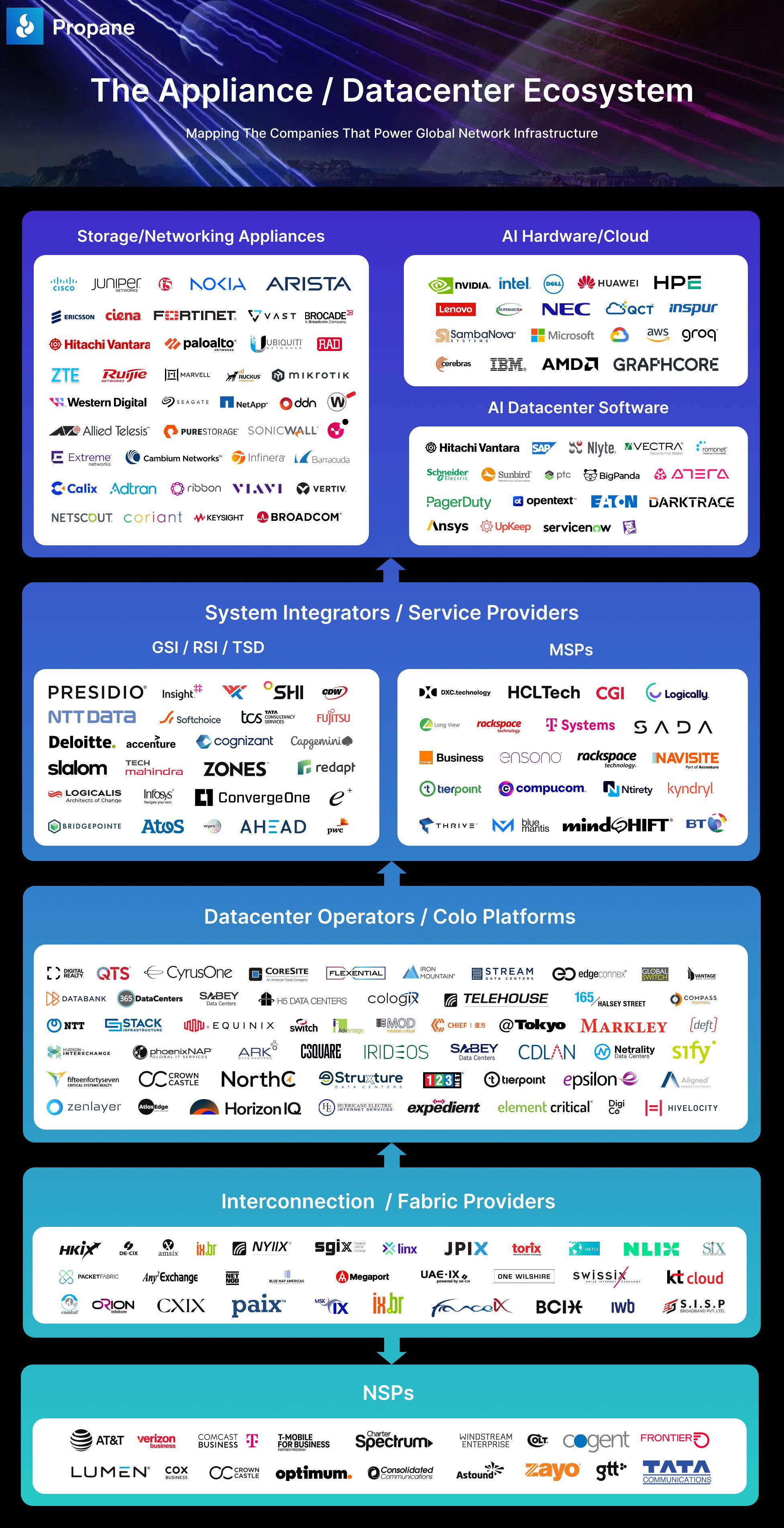
The datacenter industry is in the middle of the largest infrastructure buildout in modern history, and the supply chain behind it is far more complex than most people in the industry give it credit for.
I've spent 20+ years working with companies across this ecosystem. The thing that consistently surprises me is how compartmentalized the knowledge is. A hardware vendor with deep expertise in their own category often has no structured view of the integrators recommending their products, the MSPs managing the environments those products end up in, or the operators expanding capacity in their target markets. The same is true in reverse. Operators know their tenants and power contracts but rarely have a complete picture of the software, service providers, and interconnection platforms running inside their own facilities.
We kept running into this problem in our own client work. Every new go-to-market engagement started with weeks of manual research just to establish who the relevant players were across the supply chain. Industry reports and analyst research cover individual segments well, but nothing connected the layers into a single view.
We decided to build that view ourselves.
What the Datacenter Ecosystem Map Covers
The datacenter ecosystem map covers seven layers:
- Storage and Networking Appliances including switching, routing, security, optical transport, wireless, storage hardware, and test and monitoring vendors
- AI Hardware and Cloud including silicon companies, server OEMs, and cloud platforms
- AI Datacenter Software including DCIM, monitoring, cybersecurity, IT service management, asset management, and power management tools
- System Integrators and Service Providers including global and regional system integrators, technology solution distributors, and managed service providers
- Datacenter Operators and Colocation Platforms including major operators and regional and specialized facilities
- Interconnection and Fabric Providers including internet exchanges and network fabric platforms
- Network Service Providers including carriers, fiber operators, and global backbone providers
Every company on the map was selected based on their active presence in the ecosystem today. The full map represents the organizations that design, build, deploy, operate, connect, and manage datacenter infrastructure globally.
Why the Full Datacenter Supply Chain Matters Now
AI workloads have made the interdependencies between these layers much more urgent than they were even three years ago. A storage vendor used to be able to focus entirely on their own category without thinking about cooling capacity at the facility level. Today, the density requirements of AI clusters mean that decisions in one layer directly constrain what's possible in another. New silicon drives new server architectures, which drive new cooling requirements, which drive new power contracts, which drive new builds that are being delayed by utilities rather than construction timelines.
According to McKinsey's 2024 research on datacenter demand, datacenter capacity in the US alone is expected to roughly triple by 2030. That kind of growth affects every layer of the ecosystem simultaneously, and the companies that understand how all seven layers connect will outperform those that only see their own category.
This map is a starting point for building that understanding.
How Companies Are Using the Datacenter Ecosystem Map
- Channel partner strategists use the map as a visual reference for identifying partnership opportunities across the ecosystem. An integrator in the middle of the stack can see every hardware vendor above them and every operator below them in a single view, which is useful for planning channel strategy and identifying companies they should be engaging with but currently aren't. We've seen clients identify three or four new partnership targets within minutes of looking at the map for the first time, simply because they'd never had visibility into adjacent layers.
- Vendor marketing teams get ecosystem context that internal competitive databases typically miss. Knowing where you sit relative to hundreds of companies across seven layers informs how you position yourself, who you partner with, and where your product actually ends up in the supply chain. A category-specific analyst report will cover your direct competitors, but it won't show you the three layers of companies between your product and the person who actually makes the purchasing decision.
- Datacenter operators and colocation providers can see the full range of software tools, service providers, and interconnection platforms operating around their facilities. That kind of visibility supports business development and tenant acquisition in ways that would otherwise take weeks of manual research to assemble. When an operator understands which integrators are active in their market and which software platforms their tenants rely on, the conversations they have with prospects are fundamentally more informed.
- System integrators and MSPs sit in the middle of the supply chain and influence purchasing decisions in both directions. The map gives them visibility into which hardware vendors and software platforms are active in the categories they serve, and which operators are expanding capacity in their target markets. That context is directly relevant to how they build their go-to-market strategy and which vendor relationships they prioritize.
What Building This Map Revealed About the Industry
Putting this together confirmed a few things that are worth noting for anyone operating in this space.
The datacenter software layer is far more fragmented than most people realize. Operators are running a dozen or more tools for DCIM, monitoring, cybersecurity, asset management, and power management, with minimal integration between them. This layer gets almost no attention at industry events despite being critical to how facilities actually operate on a daily basis.
The integrator and MSP layer is enormous, and it controls more of the purchasing process than most hardware vendors appreciate. These are the companies making product recommendations, managing deployments, and running long-term managed services contracts. If you're a hardware vendor and you're not actively building relationships within this layer, the integrators are recommending your competitor's product to the end customer.
AI is creating pressure across every layer at the same time, driving demand for new silicon, new server architectures, new cooling infrastructure, new power capacity, and new network bandwidth. The companies that understand the full ecosystem will be better positioned than those focused exclusively on their own category, because AI workloads have made the interdependencies between layers much more visible and much more urgent.
Keep the Map Current
If you spot a company we missed or one that belongs in a different category, let us know!
The ecosystem changes as companies merge, get acquired, expand into new categories, and enter new markets. We plan to update the datacenter ecosystem map as the industry evolves.
We built this because we needed it for our own work and because nobody else had put it together. If it's useful to you, share it with your team.
Learn more about how Propane works with datacenter and technology infrastructure companies here.
Propane, Digital Agency - San Francisco
San Francisco, CA - 94110
415 550 8692